
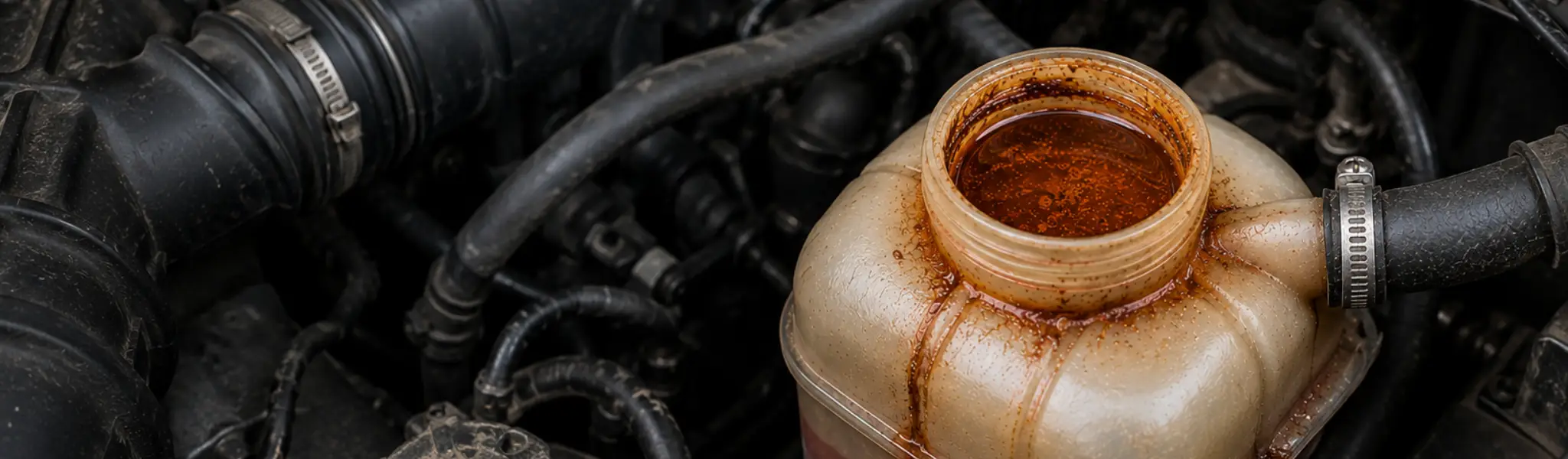
Why Is My Radiator Fluid Brown?
Rust in Coolant
If your engine coolant appears brown or rusty, there may be several reasons for it. Corrosion and rust can cause serious damage if the problem is not detected in time. In this article, we explain why coolant can become discolored and what you can do about it.
Why does coolant turn brown?
In many cases, brown coolant is a sign of corrosion or rust inside the cooling system. Depending on the engine and the coolant used, other contaminants or chemical reactions may also cause brown discoloration.
Corrosion is a chemical reaction between a material, usually metal, and its surrounding environment. In a cooling system, corrosion attacks metal components and can reduce their protective function.
When iron-containing materials corrode, small rust particles can break loose and circulate through the entire cooling system with the coolant. Since rust does not dissolve in water, these particles can turn the coolant brown and cause deposits to build up inside the system.
Unsuitable filling water can also promote corrosion. Depending on the engine, manufacturers may specify exact limits for water hardness, chloride and sulfate content, or require the use of demineralized water. If these requirements are not followed, corrosion and deposits can occur.
In most cases, the rust does not come from the plastic expansion tank itself. Instead, it usually indicates corrosion inside the cooling system. Rust particles can spread throughout the coolant circuit, clog narrow cooling passages, filters, or heat exchangers, and reduce heat transfer and cooling performance. This can lead to engine overheating. If the issue is not resolved in time, severe consequential damage may occur, including engine failure.
What should you do if the coolant is rusty?
Rust can settle throughout the entire cooling system, which means that simply replacing the coolant is often not enough. We recommend the following steps:
Flush the cooling system
Depending on the engine, a complete cooling system flush may be necessary. Always make sure to follow the manufacturer’s specifications.
Use suitable cleaning products
If the system is heavily contaminated, a special cooling system cleaner may help dissolve rust and dirt deposits. Only use cleaning products that are suitable for the application or approved by the manufacturer.
Do not use household remedies
Household products such as vinegar or other aggressive acids should not be used. They may damage aluminum components and attack seals.
Check the expansion tank
The coolant expansion tank can usually be removed. Once removed, its condition should be inspected. In some cases, it may be enough to clean the expansion tank carefully with warm water and a brush. However, if the tank has become porous or the rust can no longer be removed, it should be replaced.
Refill the cooling system
After the system has been cleaned and reassembled, it must be refilled according to the engine manufacturer’s specifications. Use only water that meets the manufacturer’s requirements, and only coolant or corrosion inhibitor products approved for the engine.
The cooling system should also be bled carefully according to the manufacturer’s instructions to prevent air pockets from forming inside the engine.
Which components should be inspected?
If you notice rust in the coolant reservoir, we strongly recommend checking the following cooling system components as well:
- Coolant expansion tank
- Tank cap or pressure cap
- Water pump
- Thermostat
- Radiator or heat exchanger
- Coolant hoses
- Seals and O-rings
Damaged or worn components may be the cause of the corrosion, or their function may already have been affected by rust deposits.
Special considerations for marine engines, generators, and industrial engines
While many passenger car cooling systems use conventional antifreeze, marine engines, generators, and stationary industrial engines are often subject to much stricter requirements.
Depending on the manufacturer, different coolant concepts may be used. In some cases, pure corrosion inhibitor concentrates without glycol are used to achieve the highest possible heat transfer. For this reason, only manufacturer-approved coolants and the specified water quality should be used.
Engines from manufacturers such as MTU, MWM, Deutz, MAN, and Volvo Penta often operate under high continuous load. Corrosion deposits can therefore quickly lead to reduced heat transfer, clogged heat exchangers, or increased stress on the water pump.
Side note: What types of corrosion can occur?
Corrosion in a cooling system does not always look the same. In addition to uniform surface corrosion, localized corrosion can also occur, where individual areas are attacked much more severely.
Possible causes include oxygen entering the system, unsuitable coolant, or electrochemical reactions between different metals. Localized corrosion in particular can remain unnoticed for a long time and cause significant damage.
Conclusion: How to prevent brown coolant
Rust in the cooling system can often be prevented by replacing the coolant regularly and following the manufacturer’s specifications for coolant and water quality. This includes:
- Following the manufacturer’s specified coolant change intervals.
- Using only approved coolants or corrosion inhibitor products.
- Maintaining the specified mixing ratio.
- Using only water that meets the engine manufacturer’s requirements.
- Regularly checking the cooling system for discoloration, deposits, and leaks.
Brown or rusty coolant should never be ignored. If the cause is identified and corrected early, consequential damage to water pumps, heat exchangers, and other cooling system components can often be avoided.
About MOPA
Since 1998, MOPA has specialized in supplying companies worldwide with engine spare parts. Today, we serve more than 2,600 business customers in 104 countries with spare parts for engines from MTU, MWM, Deutz, MAN, Volvo Penta, and Bosch.
Was this post helpful?
Thank you for your feedback!